The Friendship Quilt
Click to Enlarge
The Friendship Quilt
“This Friendship Quilt is intended as an anniversary gift to the United Nations from its member countries.“
The Friendship Quilt
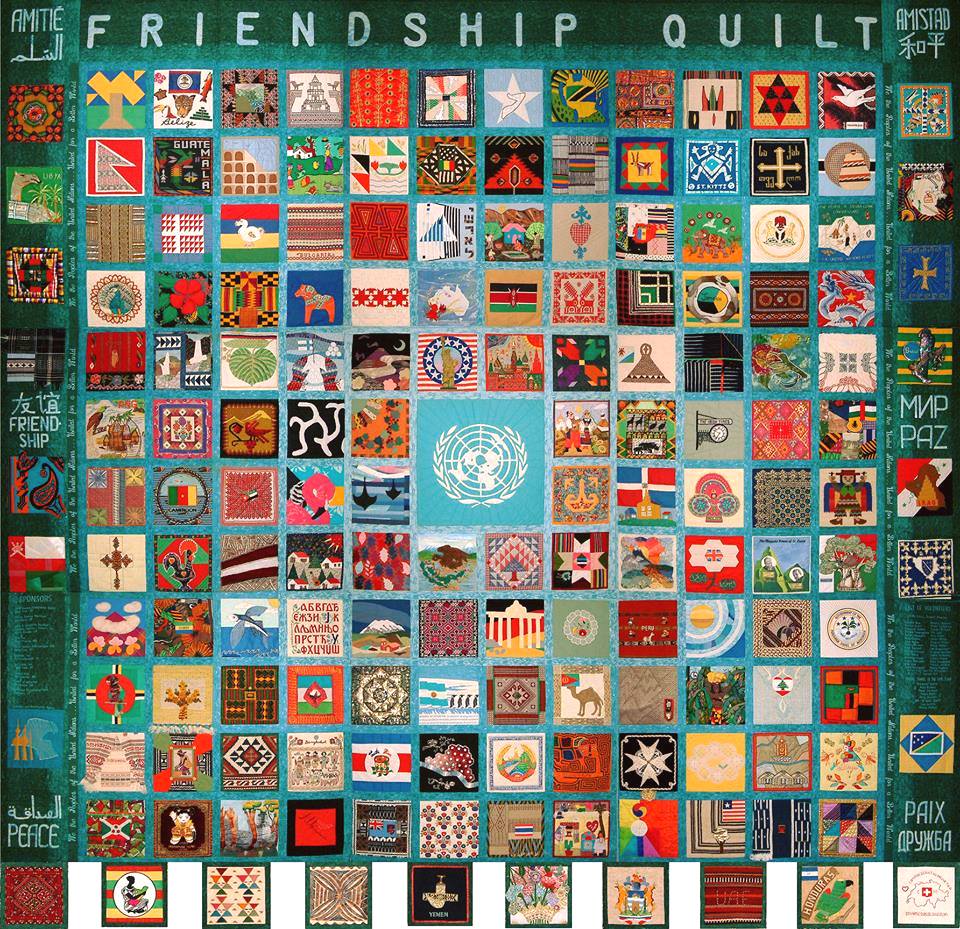
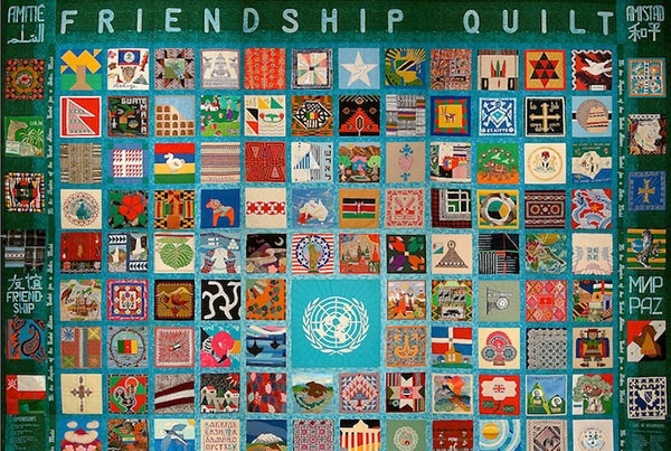
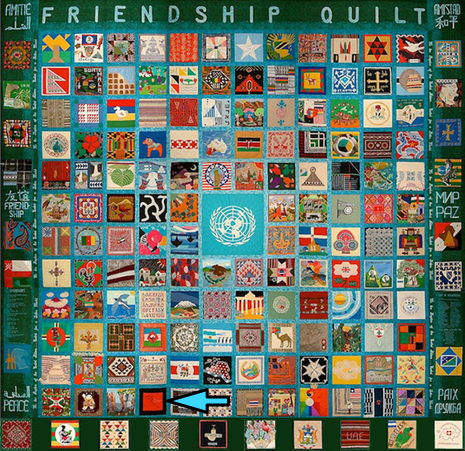
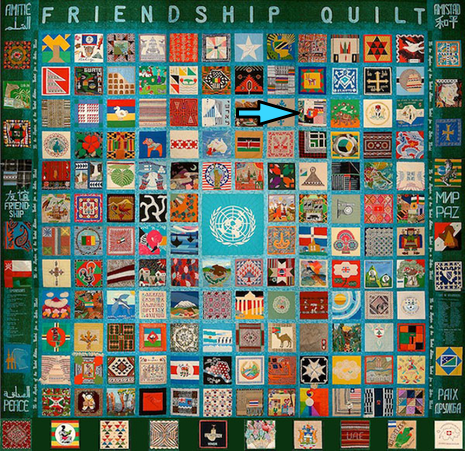
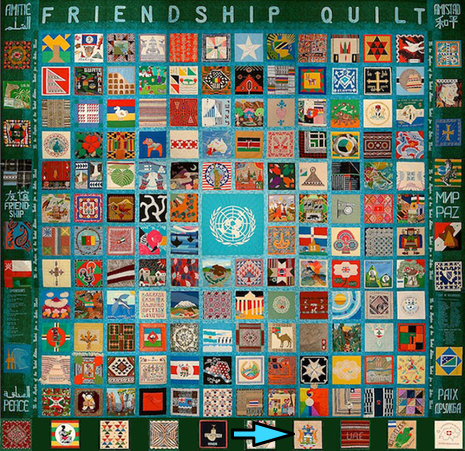
This Friendship Quilt is intended as an anniversary gift to the United Nations from its member countries. This quilt (225 square feet, 5×5 meters) was conceived by Ludmila Bokov, President of Cultural Contacts International, a non-profit organization. A group of international volunteers were working several years on putting it together. This quilt consists of 168 national patches representing UN member states who were willing to participate in this project. All patches are as different as the countries which they represent. The countries were trying to express their national emblem, symbol, totem or flag like the Statue of Liberty for the United States, Kremlin for Russia, red toy horse for Sweden or parrot for Madagascar. The side borders bear two words “friendship” and “peace” in 6 official languages of the UN: Arabic, Chinese, English, French, Russian and Spanish. This Quilt should tell the world about all the countries that strive for peace. All these patches surround blue-n-white block with the United Nations emblem. Member countries at the UN are considered as a brotherhood of the world. Therefore Friendship was chosen as the name of this quilt.
Cultural Contacts International
Cultural Contacts International (CCI), a non-profit organization, was established in 1989 in response to growing public interest to political, social and economic changes in the Soviet Union and subsequently Russia. Its goal is to conduct a cultural exchange for Russian and American textile artists engaged in quilting.
The 1990s were especially busy for our organization due to the high demand of its programs among our audience. We hosted numerous quilters from Russia to come to the United States. We staged a number of exhibitions in different American cities.
In 1990 we launched an international quilters’ exchange program “Friendship Album”. Individuals and groups, adults and children in both countries were invited to participate in making quilts together. Russian cotton fabrics were given to American participants and American fabrics to Russians. All resulting quilts made from Russian and American calicos by children and adults signified friendship between the two nations. In both countries numerous exhibitions were organized of those quilts. In the following years we continued organizing exhibitions, teaching master classes and quilting, and organizing tours for quilter groups of both countries.
Countries Participating
- Bahamas
- Bahrain
- Bangladesh
- Barbados
- Belarus
- Belgium
- Belize
- Bhutan
- Bolivia (Plurinational State of)
- Bosnia and Herzegovina
- Botswana
- Brazil
- Brunei Darussalam
- Bulgaria
- Burkina Faso
- Burundi
- Cabo Verde
- Cambodia
- Cameroon
- Canada
- Central African Republic
- Chad
- Chile
- China
- Colombia
- Congo
- Costa Rica
- Côte d’Ivoire
- Croatia
- Cuba
- Cyprus
- Czech Republic
- Lao People’s Democratic Republic
- Latvia
- Lebanon
- Lesotho
- Liberia
- Libya
- Liechtenstein
- Lithuania
- Luxembourg
- Macedoniar
- Malaysia
- Mali
- Malta
- Mauritius
- Mexico
- Micronesia (Federated States of)
- Moldova
- Mongolia
- Morocco
- Mozambique
- Myanmar
- Saint Kitts and Nevis
- Saint Lucia
- Saint Vincent and the Grenadines
- Samoa
- Saudi Arabia
- Senegal
- Seychelles
- Sierra Leone
- Slovakia
- Slovenia
- Solomon Islands
- Somalia
- South Africa
- Spain
- Sri Lanka
- Sudan
- Suriname
- Sweden
- Switzerland
- Syrian Arab Republic
- Tajikistan
- Thailand
- Togo
- Trinidad and Tobago
- Tunisia
- Turkey
- Turkmenistan
- Tanzania (United Republic of)
- Uganda
- Ukraine
- United Arab Emirates
- United Kingdom of Great Britain and Northern Ireland
- United States of America
- Uruguay
- Uzbekistan

FRIENDSHIP &
PEACE